Blog

‘The Golden Temple: Its Theo-political Status’ by Sirdar Kapur Singh

Sardar Kapur Sigh

This month’s book was ‘The Golden Temple: Its Theo-political Status’ by Sirdar Kapur Singh. A copy of the book can be found here.

Summary of key points discussed:

  • Ancient history of Amritsar’s sarovar and its relevance to Sikhi
  • Attitude of Sikhs in denying their association with previous cultures and religions
  • Background of the author Sardar Kapur Singh
  • Discussion on the doctrine of double sovereignty
    • A Sikh is first bound by truth and morality above allegiance to any country
    • The Panth should be treated a collective group rather than a collection of individuals when making political and national decisions
    • What are the implications for Sikhs today in view of the above?
  • Examples of Sikhs in power from past times and comparisons made with the above principles
  • Discussion of the misuse of power and structures within our Panth and recognition that these are not in keeping with the Sikh tradition

Full Discussion

The discussion began with many members reflecting on the new knowledge they had gained from reading this relatively short, but very well-researched and well-written book by Kapur Singh. Particularly illuminating were the historical aspects of Harmandar Sahib’s sarovar including references to its importance in Tibetan Buddhist history, the ancient Indus Civilisation and more recent cultures and the importance of sacred lakes in many different religions. These relatively unknown aspects of the Sarovar highlighted that there is a lot more history surrounding the Golden Temple than many Sikhs believe today. We have become detached from our own significance, forgetting our own place in history. The concept and design of Harmandar Sahib highlights universal principles, ‘the proposed centre of a world-culture and world-religion’. This acted to level out the diverging forces of Hindus and Muslims within India. An example of this was the Sai Mian Mir setting the foundation stone.

It could be argued that the ancient history surrounding the site of Harmandar Sahib does not feel relevant to today, but it provides balance and perspective to Sikhi as we see it today. Why did Guru Ramdas Sahib choose this particular site? The Sakhi of the yogi of Santokhsar waiting for the touch of the Guru for many centuries was particularly inspiring, especially as there is a Gurdwara commemorating this event near Harmandar Sahib. However there is a lack of common knowledge regarding this event and even at the Gurdwara Sahib there isn’t much information on the history. This may be reflective of our own Panth’s lack of awareness but also external forces who don’t want to give credence to the depth of our own theological and political history. Many Sikhs don’t like associating themselves with ‘pre-Sikh’ history but these stories are the reality of our history. Conversely it is interesting to note that other faiths such as Buddhism do not shy away from claiming an association with Harmandar Sahib e.g. in view of the fact that some of their historical figures are thought to be born there.

The members briefly discussed the background of Sardar Kapur Singh, including his instrumental part in writing the Anandpur Resolution (although he did not formally put his name to this document). It was recognised that this book did not contain as many references as would be expected. This may be because the full book has been truncated on the internet, rather than due to a paucity of references. Sardar Kapur Singh was one of the most highly recognised Sikh writers in the 1900s and was the first person to be awarded the title of National Professor of Sikhism.

One of the key concepts highlighted in this book was the doctrine of double sovereignty. This concept highlights that the state does not have the right to total power over its citizens due to the requirement of Sikhs to pay allegiance to truth and morality above all else. In this way the ideal state is observed to be pluralistic. The first obligation of a Sikh is not to be a slave but to obey the laws of righteousness. In this way, despite the Sikhs being a minority in the past (and despite the fact that they will be in years to come), this is a powerful tool for influencing bigger numbers of people.

Sardar Kapur Singh made reference to the importance of Sikhs being addressed as a group when making decisions. There were similarities to other distant empires of the past (e.g. Ottoman empires) which had societies where different sections of the community were treated as distinct groups. This is an unusual concept nowadays and is at odds with the societies we tend to live in. The importance of Panth (rather than single voices) was emphasised by the author. E.g. Maharaja Ranjit Singh himself had to bow to the supremacy of Akaal Takht, bowing to the above concept. Sardar Kapur Singh recognises that Sikhs are essentially a threat to all states due to their reliance on truth and morality as a benchmark. This clearly relies on the Sikhs of today understanding what the truth of the Guru actually means.

The point was raised that sovereign nations would never allow one group to retain distinct traditions if this contravened the law. However the chances of the Sikhs ever coming into conflict with a nation’s laws would be unlikely, unless a nation’s laws were resulting in the oppression of its citizens. Many members felt that politics and religion were intrinsically linked together and that one couldn’t go in hand without the other. Other members felt that they should be kept separate. There was a discussion regarding whether religions all feel that their individual religious beliefs are right and all others are wrong. The goal of a Sikhi is to ensure that anyone, regardless of their religion, is nurtured to be the best possible person they can be. Whether that means they are the best Hindu, best Muslim or best Christian etc. The goals of many religions of the world are to attain heaven, but a Sikh’s goal is a higher truth. So although many people think all religions have the same purpose and that we are all climbing different paths on the same mountain, this is not strictly true.

Sardar Kapur Singh didn’t make reference to Maharaja Ranjit Singh’s time of power (which many regard today as being the pinnacle of Sikh/Punjab’s glory in modern history). However he did make reference to Banda Singh Bahadur’s reign and used the experiences and decisions of Banda Singh Bahadur as an example of the Sikh doctrine of double sovereignty.

The members reflected that current Panthic organisation and structure mimics the structure of the Indian government. For example, each individual has a vote and there is a structure of committees and political parties which govern our Gurdwaras. This is not traditionally the way that our Gurdwaras were intended to be governed. But part of this influence stems from the British colonisation of India and the adoption of British customs which have been integrated into our political system.

The discussion concluded with the recognition of the significance of the last passage in the book, where Sardar Kapur Singh states that “a satisfied and properly integrated-to-the-nation Sikh people can be an invaluable and lasting asset to any state… just as a frustrated or suppressed Sikh people can an obvious weakness in the strength of the nation.”

A Zeal for Martyrdom, Kartar Singh Sarabha by Dr Gurcharan Singh Muhay

GadarNewspaper

This month’s book was A Zeal for Martyrdom, Kartar Singh Sarabha by Dr Gurcharan Singh Muhay. The book can be found here.

Below is a summary of the points discussed, followed by the full discussion.

  • Universal difficulties faced by immigrants
    • Use of legal manouvres
  • Resistance of native Indians for revolution compared with people who have emigrated abroad
  • Gadar movement
    • Admirable raising of funds relatively quickly
    • Dissemination via newspaper
    • Forward-thinking approach
    • Morality of using banditry to raise funds
  • Discussion regarding the character and motivation of Bhai Kartar Singh
  • Is the premise of foreign rule as a the sole cause of suffering accurate?
  • Impact of British Raj working with the elite classes
  • Impact of Kartar Singh Sarabha on future generations of freedom fighters

In depth analysis

The discussion started with a reflection of the universal difficulties faced by immigrants across the globe. The Sikh and Hindu immigrants described in the book were treated badly when abroad both in America and in Canada. It was commonplace to see signs regarding ‘No Indians and no dogs’ and the local population felt that immigrants were taking away their jobs due to their willingness to work for cheaper rates. There are many similarities to today’s age where immigrants are regarded negatively are prevented from entering certain countries and the book described similar injustices which the Indian immigrants faced. This injustice was partly what catalysed the Gadar Movement. Interestingly the immigrant community launched challenges through the legal system to resist the imposed immigration restrictions from the Canadian and American governments.

The Gadar party initially disseminated their literature freely through the making of a newspaper. This was initially debated as some people felt it was unnecessary, but Kartar Singh Sarabha felt strongly it would be worthwhile. Kartar Singh Sarabha organised the newspaper, facilitated translations, as well as printing and distributing the newspaper himself. The members reflected that the process of cyclostyling was no small fear and required intensive labour. The newspaper was originally published in Urdu as this was the national language, but was later translated into several other languages including Punjabi and Gujrati. It was discussed that Sikhs nowadays would not routinely want to be associated with an Urdu publication but we have forgotten that Urdu was commonly learned and understood by our ancestors.

The_ghadar_newspaper

The movement were successful in raising funds very quickly which highlighted the enthusiasm with which the immigrant popoulations responded to the idea of overthrowing the ruling English government. Branches sprung up across the globe including in the Far East, Africa and across America. The party manifesto demanded $1 from each member (when an average salary was $10 a month). Interestingly there was resistance to funding the Gadar movement from Indian villages when the revolutionaries later returned to India. It was discussed that those who have left their native country often have a wider perspective than those within a country. This, and the fact that many of the revolutionaries were very young and unattached to families, may have resulted in higher momentum within the movement.

The book made reference to previous famine in India killing many more people than the word war. This is not commonly known. The famine would have disproportionately affected the North of India, but there were enough resources from other areas for the Indian/British government to have dealt with this issue. However it was not to the government’s advantage politically to do so.

One of the interesting points raised by the book was the fact the revolutionaries felt that foreign rule was the singular cause of the Indian’s troubles. We discussed whether this was strictly true as currently Indians have independent rule and many of their troubles persist. Perhaps the revolutionaries were over-emphasising this point in order to drive up support. The reality of the situation is much less distinct but this grey area would not be talked about in case it resulted in less support.

Kartar Singh’s character and motivation was remarkable at the age of 15 when he arrived in America. He was clearly driven and ambitious and was regarded as the ‘Flying Serpent’ due to his need to keep continuously busy. He was hard-working and instrumental in spreading the literature of the Gadar movement around the world. The movement was also very forward-thinking as there was immediate recognition by its members that religious arguments would cause disunity and that the struggle was unlikely to be peaceful given the reality of the situation. In all liklihood it would involve an armed struggle, and so from the very early days of the movement plans were made for members to become trained in order to facilitate this. Despite the forward-thinking of the Gadar movement, the reality of the situation was that the British were already preparing for leaving India but were simultaneously plotting how to keep their power within the country once it was handed over. The innocent and enthusiastic nature of the revolutionaries perhaps didn’t see this but this was to their advantage as their were not disheartened.

The members reflected that war can often be a powerful way of uniting people and much innovation occurs during war-time. War and violence often results in cohesion, although it it a shame that’s what it takes at times. However war is too often used for political means. The start of WW1 prompted the return of 8000 people back to India. The Gadar movement recognised the timing of WW1 as being opportune to provoke a revolution and destabilise the existing government. However their activities had caught the attention of the Canadian, American, British and Indian governments and as a result many revolutionaries were captured, jailed and killed on their return to India. The revolutionaries were at times seen as traitors within India, and the Sikhs amongst them were even regarded as non-Sikhs. “The patriots of a subjugated country are always considered as enemies of the government of the time, and traitors of the country. They want freedom. So the government gives them a status of traitors and they are given the most deterrent punishments so that other people do not dare step into their footsteps.”

The members reflected the irony of the situation within India in the build up to WW1 as the country’s youth were being recruited to fight on behalf of the British (and were going willingly) but were much less wiling to free India from their overlords. The elite of India were also responsible for recruiting the youth to the armies, including Mahatma Gandhi. The Gadar party on the other hand were trying to prompt a revolution from the ground up which was a much tougher task. The author did not mention the other revolutionary groups of the time such as the Babbar Akaalis who were also important during this time. Perhaps this was because the author was focusing solely on Kartar Singh Sarabha. However there was mention of Bhai Randhir Singh and his group supporting the Gadar Party in their activities in India. It was good to see that during that time different groups were working together despite their differences. These days certain jathas do not associate closely with other groups who may not outwardly appear Sikh. There was no mention of the South Indians and what role they played in gaining independence. The members reflected that the more educated and integrated into society one becomes, the harder it is to remain aware of the perils of national slavery. This is even a problem today.

The Gadar movement resorted to banditry in order to raise funds from within India. This was resisted by Nidhan Singh who was Bhai Kartar Singh’s associate and second in command. The members discussed that the banditry was a weakness but also a compulsion due to the desperation of the cause. Simply conversing with many villagers was not effective in drumming up support. Occasionally after being looted a villager would listen to the revolutionaries’ cause and even donate more money. Simultaneously all humans have fallacies and it is easy to look back and reflect on whether this was the correct approach.

Ultimately, despite the Gadar movement being unsuccessful in the short-term, Kartar Singh Sarabha’s life story inspired many generations of freedom fighters to come, including Bhagat Singh who drew inspiration directly from him. Kartar Singh embraced death willingly, knowing that although he was physically defeated, his efforts would result in a much larger change. A few decades later India achieved independence successfully.

Swaane Umree Sri Guru Gobind Singh Ji by Lala Daulat Rai

guruji

This month’s book was Sri Guru Gobind Singh Ji by Lala Daulat Rai.  The book can be found here.

Summary

  • Why did Lala Daulat Rai write this book?
    • Discussion of context in 1901, author’s background and whether this influenced his views
    • Recognition that the book was originally written in Farsi and has subsequently been translated by an unknown author
  • The state of the Hindu people of India in the 1600s is similar to the state of the Sikh people today e.g. without the strength or unity to repel threats
  • Guru Gobind Singh Ji’s qualities and what we can learn from them
    • Educational background & knowledge
    • Mental and physical preparedness
    • Propagating a message in a local language
    • The challenges faced by the Guru from a young age
    • Evidence from the Guru’s writings regarding the meaning of true Dharam
  • What are the pros and cons of highlighting life-events which are not backed up by historical references?
  • A discussion on the process of religious and social reform which was taking place in India at the time of Guru Gobind Singh Ji
  • A discussion on shastar vidhya and its key principles
  • Overall reflection on the inspiration provided by this book and its unique way of presenting the life of Guru Gobind Singh Ji

In-Depth Analysis

The discussion began with the information given in the prologue by the author regarding the reasons for writing the book, namely the fact that there was no comprehensive book on Guru Gobind Singh Ji’s mission. The author also alludes to the fact that many people know very little about Guru Ji, so-called Khalsa Sikhs included. The author aims to write the book from a factual perspective, using the Guru’s own writings, and moving away from writing as an overzealous devotee. The members recognised the fact that this book was written in 1901 and many of the social issues described still ring true when looking at the problems faced by the Sikh community today e.g. the caste system, disunity and lack of worthy political power.

A lengthy discussion ensued about the background of the author, which is not clearly provided in the foreword of the book. Members felt that it was important to know this as it could have influenced the author’s views and portrayal of the Guru. On the other hand, the purpose of reading the book (and the book club overall) is to draw upon learning points from whichever text we read, regardless of the background of the author.

Some members felt that the book didn’t do justice to Guru Gobind Singh Ji, as the first third of the book spoke mainly about the Hindus and their plight, which in turn made it sound like Guru Gobind Singh Ji’s purpose was solely to save the Hindu Dharam. However, other members felt that the author clearly highlighted the Guru’s message of Oneness in all humanity regardless of faith and that this provided balance to the book.

The background context of the Islamic invasion of India highlighted how the word victory and its concept was slowly eliminated from the psyche of the common people of the time. This is comparable to the ISIS of today which attempts to enforce radical law upon the public. In the book the author describes how the Hill Rajas try to give their daughters’ hands in marriage as bargaining chips to the Mughals. The members reflected upon the irony of this; on one hand the Hindus were converting to Islam to escape the caste system which kept the common people downtrodden, but on the other hand were moving towards a system where religious identity was traded with land and titles.

One of the unique aspects of the book were the direct quotations of Guru Gobind Singh Ji’s writings which highlighted the views and thoughts of the Guru regarding the hypocrisy of society at the time. The translation of the writings make reference to ‘Akaal’ rather than God which was a surprisingly accurate representation of Sikh philosophy. The Guru had a very clear message that the religious deals that the Brahmins were engaged in were nowhere near the true concept of spirituality. The author also emphasised that Guru Gobind Singh Ji wanted to propagate the message of truth in the local language, and recognised that failure to do this would be disastrous. In today’s world, Gurudwaras are reluctant to utilise English as a method of doing parchar and see this as a threat to the status quo, rather than embracing this as an opportunity like Guru Sahib did.

It was similarly interesting to hear more about Guru Gobind Singh Ji’s early life as we often assume that Guru Harkrishan Sahib Ji was the only ‘child’ Guru, but the reality is that Guru Gobind Singh was the head of the Sikh Panth at the age of nine. The author was honest about the fact that some stories surrounding the childhood of the Guru were not validated and therefore should be repeated only with caution. Certainly there were very few solid historical references in the book and no reference list as such.

The members generally found the section describing the difficulties faced by Guru Gobind Singh Ji particularly inspiring. There were multiple attacks on the Guru with many other factions vying for the title of Guru. Guru Sahib had very few resources to utilise in his strategy against the Mughals and this was described in depth to highlight the uphill battle which faced the Sikhs. There was an emphasis on the importance of study and preparation; the author describes Guru Gobind Singh spending many years becoming a scholar and being schooled in the art of warfare. This was contrasted to our attitudes today e.g. many young Sikhs feel that education comes at the cost of their Sikhi and fail to see the two go hand in hand. Similarly Guru Gobind Singh Ji was very fond of sports, mock battles and hunting. Again today the emphasis on physical activity has been lost from our Gurudwaras. In fact the court of the Guru described in the book seems very different to the court that our Gurudwaras have made on a Sunday. The Guru utilised stories and battles to inspire his Sikhs, and drew upon ancient sagas which influenced His own poetry to make it more relatable to the masses. There was no need to invent new warriors when the myths of old provided them.

The latter third of the book was dedicated to describing the several battles fought by Guru Gobind Singh Ji’s army. The army is initially described as ill-prepared, and makes it sound like this was the first time that the Sikhs had engaged in combat. However obviously we know that Guru Hargobind Sahib had prepared the Sikhs for battle many years previously and so the author’s description seems unlikely. This led to a discussion about the true art of Shastar Vidhya and how this form of discipline has been forgotten by the mainstream Sikh community and reduced to the Iranian influenced ‘Gatka’ demonstrations rather than maintaining its traditional Sikh values.

We completed the discussion with the recognition of the Guru’s true embodiment of the Chardikala concept and the fact that this was integrated into a message of religious, political and social reform.

‘The Sikh Army’ by Ian Heath and Michael Perry

sikhsoldiersThis month the book club discussed the book named ‘The Sikh Army’ by Ian Heath and Michael Perry. The book can be found here.

Brief Summary of Discussion:

  • Context & style of the book
  • European and British opinion more predominant than Sikh opinions
  • Focus on modernisation of the army
  • How Maharaja Ranjit Singh came to power
  • The population and make-up of the state and the army
  • Recognition of the misconceptions we have about the soldiers who made up the army, and the battlestandards and uniforms used
  • Disciplinary procedures of the army and the financial system
  • The Akalis and their contribution to the army
  • The demise of the Khalsa state


In-depth Analysis:

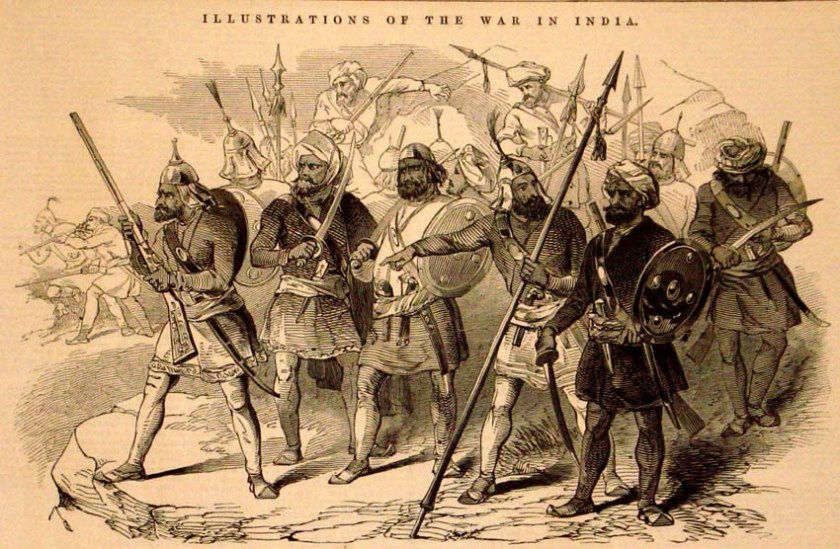
The discussion started with recognition of the fact that this book is part of a wider series and that all of the books in the series were rather technically written. The book dissected each aspect of the army and explained its individual history, rather than following an overall chronological view of how the army developed. This is likely to be in keeping with the style of the whole series. It was commented that the book was written from a European perspective rather than a Sikh or Indian perspective, and therefore possibly did not provide the whole picture of the army at the time. There was some discussion about why this might be. For example, it is possible that more European references exist today rather than Sikh/Punjabi references. Similarly any references from the Khalsa Raj were likely to have been written in Persian or Farsi (the official language at the time) and therefore may not be readily available for a Western author to interpret.

The British opinions were more predominant, with writers describing the Sikhs as not really being much of a threat. At the time time, some British evidence e.g. by the Lord Auckland’s sister Emily Eden, suggested that the Sikhs or Sarkar-e-Khalsa  were viewed as quite a significant threat but that attempts were made by the British to hide this. Certainly we know that at times the British army was definitively defeated by the army of the Raj, and that the Sikhs had some particular skills which were intimidating to the British e.g. the way in which they attacked and fought in close combat.

The focus of the book was on the regularisation or modernisation of the army, possibly because this had such a strong influence on the persistent strength of the Sarkar-e-Khalsa. Prior to this time the Sikh’s strength lay in guerilla-type warfare and tactics, where the Khalsa were able to attack at will and retreat at will into the jungles. This type of warfare is effective to an extent, but the political climate was changing and Maharaj Ranjit Singh had the foresight to anticipate a war with the British. He recognised the limitations of this type of warfare and the need for a more formal structure to the army and a longer-term strategy. Moreover he sought advisors from the French King Louis to prepare for this.

The book began with a very brief outline of how Maharaja Ranjit Singh came to power and the author implied that it was done via a ruse or trickery of some kind. The discussion involved a debate as to whether the tactics employed by Maharaja Ranjit Singh were necessary to achieve unity and there was recognition of the fact that he was clearly a clever, far-sighted individual who used situations to his advantage in order to achieve a united nation. Prior to this, the misls were described as fighting amongst themselves. This was less than a hundred years after Guru Gobind Singh Ji’s time on earth and it took only that much to result in in-fighting amongst the Sikhs. Other native Indian rulers had tried to consolidate power as Maharaja Ranjit Singh did, but they had previously failed in their attempts. Along the same thread, the topic of Sarbat Khalsa came up and the fact that as Maharaja Ranjit Singh consolidated power, this medium was no longer used as a method for making decisions regarding the panth, with the last known assembly taking place in 1805 during this time period. The author did not comment upon this directly but indirectly stated that Maharaja Ranjit Singh’s rise to power changed the face of the Sikh nation whereby decisions were no longer made by assembly but through the monarchy.

The author highlights that the population of the Khalsa State was 3 million and there was some queries as to whether this was an accurate figure. Regardless, it is clear that Sikhs were actually still a minority even during the time period covered by the book with the author making reference that Sikhs made up a sixth of the population. Sikhs were portrayed as reluctant to accept discipline or European way of doing things within the army, and this rang true which some of what we see in our communities today.

Later on in the book the author describes how the artillery wing of the army is predominantly made up of Muslim soldiers, and the army is depicted as being very multicultural with soldiers from all over the empire and beyond. Maharaja Ranjit Singh paid soldiers more than the East India Company and therefore European deserters were also part of the army. This highlighted that the traditional pre-conceived notion of the army being made up of purely Sikh warriors is flawed. The uniforms used were not in the so-called traditional Khalsa colours but were in red, yellow, white and blue. People generally found the descriptions of the different sections of the army illuminating and the pictures in the book added to the readers’ experience.

Amongst the pictures were references to the standards or Nishan Sahibs used during the time period. There was acknowledgement from members that the current Nishan Sahib which we associate with Sikhi is a modern creation, and that Maharaja Ranjit Singh’s army used varying Nishan Sahibs, possibly to distinguish battalions, and sometimes incorporating other cultures such as the French tricolour. One of the flags from the time lies in Lichfield Cathedral, although apparently is rather faded now.

We discussed the disciplinary procedures used by the army, and reflected upon the brutality of removing soldiers’ hands or ears. The western or european armies of the time enforced this kind of discipline and this was perhaps a feature of the army’s adaptation to european ways. On the other hand, the financial system employed by Maharaja Ranjit Singh was outdated and very traditional (essentially the Mughal system was adopted and taken over) and so this wasn’t modernised at all, in contrary to the army.

The section on the Akalis was well-received by members. We discussed the fact that the Akalis didn’t necessarily agree with the way in which Maharaja Ranjit Singh went about things, but they did agree to fight with him on some occasions. We discussed the fact that Maharaja Ranjit Singh’s character may not have been in keeping with that of the Akalis which created tension, but that his overall aim in keeping the British at bay resulted in a love-hate relationship between him and the Akalis. Taking reference from outwith the book it was discussed that Maharaja Ranjit Singh employed tactics such as having female body-guards surrounding him to discourage men from throwing things or launching assassination attempts. The Akalis were not incorporated into the army but were kept at bay and only used when needed. Their bravery perhaps resulted in their numbers decreasing as they were used for the most desperate of battles, having an attitude that ‘bordered on insanity’ and resulted in no fear of death.

Each unit within the army was prevented from having a discreet identity in order to ensure that no one faction had the potential to dominate the army. Perhaps this was one reason why the Akalis were not fully integrated into the army. The ultimate rise of independent power sources within the state probably ultimately led to the downfall of the Raj, as these became dominant and exerted their influence.

The demise of the army was not fully covered within this book, and it was felt by members that this was disappointing as it is crucial for Sikhs to learn from this. Clearly Maharaja Ranjit Singh hadn’t fully planned for the future, or perhaps his heirs were simply unlucky in being betrayed, killed or forcibly removed from seats of power. The Raj was reliant upon a blood-relative being a successor, something which has never been the case before in Sikh history. Is this the best way to maintain a Sikh Kingdom? The end of the book left more questions than answers and highlighted the tragedy of the Sikh Raj.

The novel ‘Bijay Singh’ by Bhai Vir Singh

banner1

Below is a summary of our third meeting on 12th March. The book discussed was ‘Bijay Singh’by Bhai Vir Singh.

The book can be found here.

Brief summary

  • Discussion of why Bhai Vir Singh wrote this book
  • Why are Sikhs ignorant regarding their history even today?
  • Do English translations ever truly represent the emotions/poetry of Punjabi literature?
  • Discussions of the characters of Bijay Singh, Sheel Kaur, Waryam Singh and the Pundit
  • Bijay Singh had to survive in a tough political climate
    • How does political culture influence our own actions today?
  • Many of the issues raised within the novel are highly relevant to today’s society and battles
  • Although initially appearing one-dimensional, the characters in the novel have certain subtleties which make them more realistic
  • Is compromise ever acceptable to justify survival?
    • Perhaps all parts of the Panth have individual roles to play in Sikh struggles even if their roles appear to be vastly different or questionable
  • Was it justifiable for the Sikhs to work with/for the Moghuls?
  • The novel’s nostalgic portrayal of the past is sometimes overpowering and possibly inaccurate
    • Do we endanger ourselves by forgetting the mistakes of the past whilst aiming to recreate the good old days?
  • Is modern day luxury necessarily a bad thing?
  • At times Bhai Vir Singh makes genuine pleas to the sangat but is his writing influenced by misogynistic attitudes regarding concepts such as honour?

In-depth Analysis

The discussion opened with a summary of why Bhai Vir Singh wrote the book. He outlines this in his introductory commentary and cites ‘stemming the rot of ignorance’ that has befallen the Sikhs as one reason. 100 years ago he felt that Sikhs were forgetting their history and the struggles their ancestors had to go through, but why has this not changed today? We reflected upon the fact that the Gyanis of today are not fulfilling their potential roles as educators of the community, and that Sikhs generally are reluctant to associate with anything that requires discipline, despite the fact that discipline and Sikhi go hand in hand. Unless something is placed on a plate in front of us, we don’t make an effort as a community to read our history or any other books. This may be improving with the use of social media and video-sharing as a means of education the masses now.

We went on to discuss the character of Bhai Bijay Singh who we know little about prior to his transformation to a Singh. The author portrays him as undergoing a rapid transformation from a frail, scrawny person to a lion-like individual of strength. He is clearly at a very high spiritual level, seeing God within all, but there is little to guide us as to how Bijay Singh attained this state and over what time period. The possibility of things being lost in translation was raised – perhaps we are not able to understand the full extent of Bhai Vir Singh’s writings if we only read in English. Although Bijay Singh seemed like a one-dimensional character (the Ideal Man), there were times where he had doubts about what was right or wrong, and these doubt made him seem more relatable to the reader.

In the same way, it was mentioned that Sheel Kaur has to undergo many tribulations of her own and is portrayed as a picture of innocence and beauty. However there are many times when she doesn’t know what to do, but relies upon Ardas and faith to guide her. She seems to have an unflinching belief that the answer will come from Guru Ji no matter what.

One of the most shrewd character was the Pundit who was always keeping in mind his own self-interests. It was interesting how that character felt quite realistic and also how he would convince himself that he was doing good even when he was essentially complicit in attempted murder. Perhaps Bhai Vir Singh was illustrated the self-obsessed Manmukh compared with the Gurmukh Bijay Singh.

At the start of the book we witness Bijay Singh’s family being informed about his conversion to Sikhi. Their shock and fear is partly due to the political climate in which they live. For example his mother knows that being a Sikh is a positive thing, but feels that Bijay Singh should ‘do it quietly’ rather than letting people know about it. There was a discussion about how politics of the time influences us even today. Along a similar vein, there was some discussion later about how Sikhs at times compromised their appearance or other aspects of their lives in order to survive. There was recognition in the novel about how this was sometimes necessary e.g. to ensure a safe house was preserved for underground operations, or maintain the sanctity of a Gurdwara by disguising it as a hut. In the book there are times when one must fight, but also times when one must work with the authorities and use this to one’s advantage. Rather than judging those individuals who felt they had to compromise, perhaps we should recognise that they were simply playing their part in preserving the Panth in their own way. As a Panth we should be united, and the novel made reference to the fact that a palace is built on four walls of equal strength (a casteless society). If one of the walls is uneven or unequal the building will not stand.

We know that Guru Gobind Singh Ji dressed as a Pir at times to serve a greater purpose. Similarly Bijay Singh at one point dresses like a Ranghar, despite previously placing high emphasis on the preservation of the Sikh identity. There seemed to be times where the Sikhs were portrayed as being highly innocent, and there was a discussion about whether this was naivety or evidence of true devotion. There were some examples within the novel of Sikhs being taken advantage of (or allowing themselves to be taken advantage of) e.g. placing themselves in danger when a soldier was pretending to be injured or remaining a prisoner in the Begum’s palace. Were these types of decisions pure gullibility or was there a greater reason for why the Sikhs in the novel felt that suspicion was an evil? Perhaps the characters were making calculated decisions based on their intellect, knowing all the while that Hukam would lead to whatever outcome.

We discussed the role Bhai Vir Singh himself played in the novel. At times he broke away from telling the story to address the reader. He seemed to place emphasis on the fact that the old times were harder but also simpler and therefore better in some way. Luxury is mentioned as something which is negative and not compatible with spiritual growth. Is this in line with Gurmat when Guru Sahib talks about living a householder’s life? During our discussion the point was raised that we do ourselves a disservice by forgetting the mistakes of the past e.g. the negative attitudes toward women. If we continually hark back to the old days and year for their return, we will essentially be repeating our mistakes again and again. Similarly Bhai Vir Singh’s views are intrinsically linked within the novel as he discusses the fact that a Sikh cannot live without honour, to the extent that suicide is portrayed as a viable option in that case. Again we wondered whether that was in line with Gurmat, or whether the writers misogynistic Punjabi background was influencing the content of the novel. One of the examples of this was at the end of the novel when Sheel Kaur apparently dies of separation from her husband Bijay Singh, despite the fact that she has a responsibility to her son Waryam Singh. This was reminiscent of the Indian tradition of Sati, but perhaps Bhai Vir Singh was employing this as a purely artistic expression to provide an ending to the novel.

Overall the majority of people found that this novel was worthwhile reading, and although initially full of ‘good’ and ‘bad’ characters, there were many messages which are highly relevant to today’s society.

Ego (Guru Granth Sahib Speaks) by Surinder Singh Kohli

ego

Below is a summary of our second meeting on 12th February. The book discussed was ‘Ego’ from a series called ‘Guru Granth Sahib Speaks’ by Surinder Singh Kohli.

A copy of the book can be found here.

Brief Summary

  • Terminology used in the book
    • Haumai, Ahamkara
    • Origin of the words, their use in Hindu philosophy
    • Purusha and Prakriti leading to intellect
    • Rajo, Tamo, Sato and the fourth state
  • Maya
    • What is Maya? Is it good or bad?
      • Attachment to Maya is what takes us away from Akaal Purakh
      • Maya is a necessary part of life in many way
    • Through Maya the self believes it is an individual
      • This duality separates us from God
    • We link with Maya through the senses
      • Through controlling the senses one can progress
  • Ego
    • Everything we do is in ego, this is the root of all problems
    • There is no room for ego when the mind is focused on Naam
    • The cure for ego is within ego itself
    • Everything we think is own is a gift
    • Both virtuous and non-virtuous acts are as a result of ego
      • So is virtue alone enough to overcome ego?
  • Hukam is part of the laws of nature
    • Individuals have duties but there are limitations to this
    • Individuals working on three planes: mental, physical and spiritual
  • The mind
    • The mind has the potential to uplift us spiritually but can also wreak havoc
  • The body
    • Recognition of the importance of keeping the body strong, healthy and pure
  • Naam
    • Doing simran is one step towards overcoming ego
    • Mere recitation is not enough but may be the first step
    • What are the next steps?


The meeting began with a discussion on the terminology used in the book. We often use the words Haumai and Hankaar interchangeably but the author highlighted that Hankaar/Ahamkara refers to superiority, whereas Haumai (separation) is the root of all other evils e.g. the five thieves. There was recognition of the vast references in the book to multiple authors within Gurbani. This highlighted how important the concept of ego is in Sikhism, and how it has been described in many ways by all the Gurus and Bhagats that contributed to Gurbani.

It was interesting to note that some of the words referenced by us in Sikhism today (such as Haumai) first appear in texts which were written many centuries before Gurbani was written. We discussed the fact that there are some truths in the world which permeate throughout the ages and are relevant to all of humanity regardless of religion.

Not many people in the session were familiar with the words Purusha and Prakriti, and the fact that these two concepts result in the formation of intellect. However we did recognise that the Purusha has links with the word Purakh and that Prakriti also appears in Dasam Bani.

We talked about the authors translation of Rajo, Tamo and Sato (passion, morbidity and rhythm) as attributes of Maya. There was some discussion of what these words mean in Sikhi e.g. Sato can be described as virtue, Tamo as atrocities and Rajo as worldly aspirations. Everything we do can be categorized into one of these states. Even good actions can be regarded as part of Maya. Sikhi talks about a Fourth State where one rises above these aspects of Maya in an egoless state of mind. There was recognition that having an awareness of these categories could be one of the first steps in advancing one’s understanding of Sikh philosophy.

Guru Ji created concepts such as seva and kirat. If these acts cause ego to arise in the mind then the battle is being lost. Neverthless they are important acts to keep us on track when we walk on this path as they encourage spiritual growth. However virtuous acts alone cannot truly lead to us destroying the barrier of separation that we feel between ourselves and God. A Sikh almost has to live on three planes, as the author describes; mental, physical and spiritual planes. We must keep our bodies healthy and strong in order to survive and enhance our spirituality. Similarly we must keep our mind engaged in Maya to some extent in order to survive in the world, whilst not becoming too attached. Guru Nanak Dev Ji talks about us being born into the world with nothing, but as we progress through the different stages of life we accumulate ego in a number of ways. However at the end of life we all die and even though we may have been very proud of the turbans we tie on our heads, even those heads will be used by the crows to clean their beaks.

This led onto a point being raised about how Bana was introduced by the Guru to lower one’s ego, and make everyone dress in the same way. However today we have turned things around and instead when one dresses like a ‘Gursikh’ it actually serves to enhance one’s ego. All that a person has really done is change their clothes if internally the ego remains the same.

There was a discussion about Maya and what it encompasses, including whether it is good or bad. We recognised that Maya is essential for survival in this world, and that we should only engage with Maya as much as is necessary. There was debate about the fact that different people have different ideas of what is necessary in life. Gurbani clearly encourages us to live within Maya but stay detached from it. But some degree of attachment is necessary, e.g. a mother having a maternal bond with a child in order to provide them with shelter and food. Similarly we cannot do our jobs by completely ignoring Maya. Becoming attached to Maya is what takes us away from spiritual growth, but Maya in itself cannot be considered as ‘bad’ as it was created by God.

This led to a question about whether ‘good’ and ‘bad’ are actually two separate entities. In many religions good and evil as described as polar opposites. In Sikhi the lines are much more blurred because there is recognition that God created everything, including what humans considered to be ‘good’ or ‘bad’. The majority of time we define good/bad depending on how things affect us personally. The example of natural disasters was used to reflect on how humans deal with ‘bad’ things happening. Bad can be considered an absence of good and vice versa, just as cold is the absence of heat. Ultimately cold, heart, light and darkness is just the transfer of energy. They are not separate forms in their own right. Continuing to use terminology such as ‘good/bad’ promotes duality in our minds. Despite the recognition of this fact, it was noticeable that we all kept introducing these words into the meeting throughout, perhaps highlighting the extent to which we have all been conditioned to think in this dualistic way.

In the same way that there is no room for darkness when there is light, there is no room for ego when there is Naam. We discussed what Naam can mean, and whether this is simply the physical utterance of one word. Even the utterance of the word Vaheguru (God is great) demands recognition of the Divine and nothing else, and this can be powerful. Practising recitation can eventually lead to spontaneous recitation or the incorporation of Naam into everyday life. The whole world/nature can be thought of as being engrossed in Naam Simran as it is attuned to the One in a harmonious rhythm. The question was asked that doing Simran is one step, possibly one of the earliest steps one can take on this journey, but what is the next step after that? Is the next step seeing God in everyone? Or is it having an awareness of when you feel ego taking over your mind? In the same way that a teacher can describe all the stages of understanding to you in one lesson, sometimes the only way for the student to gain a true understanding of the content is by working through each step one bit at a time.

The mind is very difficult to control as it wanders in many directions at the same time, like the junctions of a busy train station. Even when attempting to still the mind all sorts of thoughts can arise. Doing Naam simran might be one way to begin to control the mind.

In the book, the author makes reference to Gurbani saying that ego’s remedy is within itself. This is a puzzling concept as it’s saying, in order to rid oneself of ego, one needs to employ ego initially. Maybe this means that initially we have to take one step towards God. That might come from a place where we still consider ourselves an individual, separate from God, in Haumai. However that step is crucial in subsequently getting to an egoless state.

Brahmgyan by Sant Singh Maskeen

brahmgyan_1

Below is a summary of the discussion from our first meeting on January 15th.

The article discussed was Brahmgyan by Sant Singh Maskeen.  A copy of the article can be found here.

Brief Summary

  • Knowledge
    • Can knowledge be divided into only two categories?
    • Is acquisition of material knowledge a bad thing or is it necessary?
    • What mindset do we have when acquiring any type of knowledge? Is it one of ego or one of humility?
  • How do we look inside ourselves?
    • What does Gurbani say about how to go about doing this?
    • How can we still the mind?
  • Is time relevant in Sikhi?
    • Are human timelines meaningless or important?
    • How can we use the concept of time to our advantage?
  • Is it wrong to adopt or celebrate other faiths’ festivals?
    • Are we being influenced by Christianity at the cost of our own culture?
    • Why do we feel we can accept some religious festivals such as Christmas but not others from different faiths?
  • Antarmukhi and Baharmukhi
    • What is the difference between inward facing and outward facing?
    • Was Guru Nanak Dev Ji’s mission to enhance our identity or to break it?
    • Where does our sense of self/identity come from?
  • Simran
    • Is there a difference between Simran and Naam Japna?
    • Do we limit ourselves by considering these two concepts the same?

There was some debate about different types of knowledge, and whether it is even right to divide knowledge into only two categories (materialistic and spiritual). Some felt that materialistic knowledge was no better or worse than spiritual knowledge and that Sikhism encourages us to learn all types of knowledge. We all agreed that acquisition of knowledge isn’t a bad thing, but that the mindset which accompanies such knowledge is more important. For example, if acquiring knowledge only brings about ego then one’s mindset should be altered to prevent this.

Someone raised an interesting point about how humans are the only animals on the planet who suffer with ego and that this is the biggesgt downfall of humanity. We later realised that some animals also do demonstrate egos (like gorillas who beat on their chests to maintain their dominance) but this is probably besides the point!

We went on to talk about how we look inside ourselves. The hardest thing to do is reflect upon ones own actions and thoughts. Someone mentioned that humans in general do things because they think they are correct in whatever they are doing. If they didn’t feel it was correct then they wouldn’t do what they’re doing. There was a brief discussion about whether reflecting within oneself is actually feeding one’s ego (as you are focusing on yourself). Gurbani obviously encourages simran as a way of avoiding this, focusing on the light within, rather than one’s body or mind or ego.

Regarding time as a concept, time is relative. The word Akaali means timeless/deathless, because even through death the light/soul continues. Do we even know how old we are? Every woman is born with all her eggs already inside her. Therefore, a piece of us existed even inside our grandmother. Yet we think we know everything about ourselves, including certainty about our age. In reality we are all much older than we think we are. Time from a spiritual point of view is probably irrelevant, but it can act as a strong motivator i.e. life is running out, remember Waheguru.

Is it wrong to adopt other cultures’ celebrations and dates? Are we all Christianised to some extent? From a wordly point of view it is important everyone has a similar timeline in terms of organising national economies, trading etc. There was some lively debate about whether New Year should be celebrated or not, and whether it really means anything. From a spiritual point of view these dates are arbitrary. However it was recognised that as a Sikh nation we all know important Christian dates (like the birth of Jesus) but we don’t know our own Guru’s stories or Gurpurabs. So it might be alright celebrating non-Sikh festivals, but if this comes at the cost of forgetting our own history then maybe we need to think again. Interestingly it was mentioned that we feel Christian festivals are ‘ok’ to celebrate because they are widely accepted, but a question was raised as to who would be just as willing to celebrate Eid? Why do we feel some cultures are acceptable and others aren’t?

Antarmukhi vs Baharmukhi (inward facing and outward facing), these concepts are similar to Manmukh and Gurmukh. Before looking internally, you have to lower your ego. Or maybe looking internally is actually what lowers your ego in the first place. We talked about how Guru Nanak’s mission was not to enhance our sense of identity, but to smash it completely. Using the analogy of building a brick wall, we attach importance to every aspect of our identity. For example, I’m a student (add a brick), I’m a daughter (add a brick), I’m male, I’m female, I’m a doctor, I’m a driver etc. All of these are bricks which we place around us, and we use this wall to build our identities. But take away every single brick and what’s left? What’s left is the atma, the light that binds all of us and Akaal Purakh. So by talking about Ik Oangkaar, Guru Ji wasn’t trying to cement our identity, he was trying to smash it.

We finished off by briefly talking about whether there is a difference between doing Simran and Naam Japna. Someone said that this was similar to deciding whether to call a turban a Pagh or Dastaar. Others felt that Naam Japna is something which you consciously make an effort to sit down and do for periods of time, whereas simran was more of a constant remembrance in every day life, or having an awareness of Waheguru (rather than physically saying the word Waheguru with your eyes closed).